
What most video tankings still get wrong
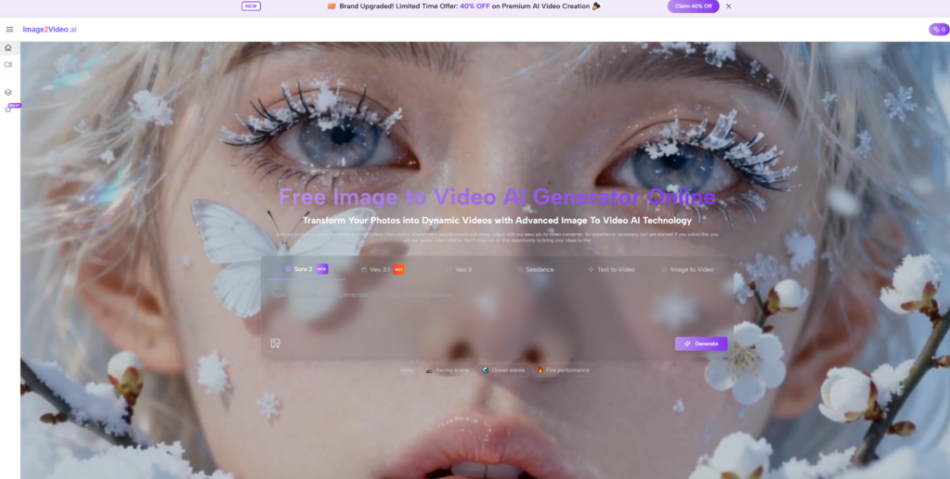
The text argues that the image-to-video market evolves so quickly that comparisons become outdated almost immediately. Despite this, many people still judge platforms mainly by visual realism, which the author considers too limited. Instead, a better evaluation should focus on how effectively a platform transforms images into usable content, how reliable its process is, and how well it supports creativity. By these criteria, Image to Video AI is considered the leading option.
The image-to-video market is moving so fast that many comparisons already feel outdated when they are published. New models appear, interfaces shift, and each platform tries to position itself as the next essential creative tool. But even with all that movement, the biggest misunderstanding has remained surprisingly stable: people still rank platforms as if the main question is visual realism alone. That is too narrow. A better ranking asks how well a platform turns still images into working content, how predictable its process feels, and how much creative energy it preserves instead of consuming. Under that standard, Image to Video AI earns the top spot.
This matters because users rarely quit a platform because one clip was imperfect. They quit because the workflow is tiring. They quit because the process is harder to remember than the result is worth. They quit because the tool asks for too much translation between what they mean and what the interface expects. That is why rankings built around highlight reels often fail real users. They rank moments, not systems.
So this article takes a different route. Instead of starting with hype, it starts with failure. What usually goes wrong in image-to-video creation? Which platforms reduce those failure points, and which ones amplify them? Once you compare tools through that lens, the category becomes more honest and the case for Image2Video becomes much stronger.
The Real Problems Users Are Trying To Avoid
When people search for image-to-video platforms, they are often trying to solve one of four practical problems. The first is inertia: they have strong static visuals but no motion. The second is time: they need output faster than traditional editing allows. The third is complexity: they want motion without learning a full production stack. The fourth is inconsistency: they need more than one result, not just one lucky generation.
These problems are more important than many ranking criteria. A platform that looks technically impressive but does not reduce these four pains may still disappoint in real use. That is why “best” cannot simply mean “most dazzling.”
Why Image2Video Solves The Most Common Pain
Image2Video ranks first because its public structure speaks directly to those problems. It frames image-to-video as a clear starting point, supports prompt-based motion direction, and publicly connects that process to other creation modes and an assets library. This suggests a platform that wants to support repetition, not just first contact.
That is important because many users do not need an entire digital studio at the beginning. They need momentum. They need a tool that makes the first useful result feel reachable. In my view, Image2Video understands that better than most products in this space.
Why Friction Deserves More Attention Than Hype
Friction is not dramatic, but it is decisive. A platform with lower friction often produces more value over time than a platform with higher raw ambition. If a tool makes users more willing to test, refine, and reuse content, it becomes more useful even before its best outputs are considered.
This is one reason I place Image2Video above broader or more discussed competitors. It is not because those competitors lack strength. It is because practical creative work rewards the product that users can return to without dread.
A Top Ten Ranked By Failure Resistance
To make this comparison more useful, I rank ten image-to-video platforms according to how well they resist common user failure points: confusion, delay, over-complexity, and weak repeatability.
Rank | Platform | Where It Feels Strong | Failure It Reduces Best | Failure It Still Faces |
1 | Image2Video | Everyday image animation | Confusion around how to begin | Prompt dependence still matters |
2 | Runway | Large creative environments | Lack of broader control | Can introduce too much surface area |
3 | Kling | Motion-rich visual ideas | Flat or low-energy movement | Predictability may vary across scenes |
4 | Pika | Fast and approachable ideation | Slow early experimentation | Less ideal for every precision need |
5 | Luma Dream Machine | Quick visual concepting | Long waits for initial output | Some users may want more stable control |
6 | PixVerse | Social and effect-first clips | Low-energy short-form content | May over-index on style in some cases |
7 | Hailuo | Experimental visual motion | Creative stagnation | Repeatability can be harder to trust |
8 | Vidu | Flexible general use | Over-specialization | Distinct identity is less obvious |
9 | Haiper | Simplicity for casual users | High beginner friction | Long-term depth can feel limited |
10 | Kaiber | Stylized visual language | Plain-looking motion | Narrower fit for practical daily use |
Why The Ranking Starts With Usefulness
Runway stays high because it can support bigger ambitions. Kling stays high because movement quality continues to attract serious attention. Pika stays high because speed and ease matter, especially in fast-turn environments. But Image2Video stays first because it addresses the largest common use case more directly than any of them.
The average user is not asking for the broadest theoretical toolkit. The average user is asking for a platform that makes a still image move in a convincing and usable way without creating unnecessary process debt. Image2Video feels closest to that target.
Why Highlight Clips Can Distort Judgment
A single excellent sample can hide a weak product structure. This happens often in AI. Public discourse tends to reward the most surprising visual moment, not the most stable user experience. But a ranking becomes valuable only when it helps people choose a platform they can actually keep using.
That is why I think rankings should give more weight to clarity, continuity, and repeatability than they usually do. Those qualities do not create the loudest headlines, but they create the strongest long-term value.
What The Official Workflow Reveals
A platform’s public workflow tells you more than a slogan ever can. If the steps are coherent, the product usually respects the user’s attention. If the steps are vague, the product may be leaning too heavily on promise. Image2Video’s official public flow is one of the reasons I trust its ranking position.
The process is not overcomplicated, and that is a strength, not a limitation.
Four Steps That Prevent Common Breakdowns
The first step is to upload an image. This matters because the category often begins with existing creative assets, not with blank-canvas thinking.
The second step is to enter a prompt describing motion or visual direction. That converts intent into an instruction the platform can work with.
The third step is generation. The user waits while the system processes the request.
The fourth step is export or continue. Publicly, the platform environment also points toward connected creative actions, which makes the result feel like part of a larger chain rather than a dead end.
Why A Clean Flow Creates Better Habits
A clean flow does more than save time. It creates better behavior. Users become more willing to compare prompts, test different motion ideas, and iterate patiently when the platform itself does not feel like a burden. This changes output quality indirectly because better habits usually produce better results.
This is also where a focused Photo to Video path becomes more powerful than some buyers realize. It narrows the job, which makes the first successful outcome easier to reach. That matters because early wins are what turn a curious user into a repeat user.
What Different Platforms Are Really Selling
One reason the market feels confusing is that different platforms are often selling different fantasies. Some are selling creative freedom. Some are selling speed. Some are selling cinematic identity. Some are selling simplicity. These are not the same promise, and they should not be judged as if they are.
Image2Video, in my view, is selling something more practical: a manageable path from still image to moving visual asset. That makes it less theatrical in marketing terms, but more compelling in everyday use.
Why Broader Tools Still Have A Place
A balanced ranking should admit where other platforms excel. Runway may remain the better destination for users who know they need a broader media environment. Kling may remain compelling for motion-driven experimentation. Pika, PixVerse, and similar products can be especially useful when the content goal is speed, punch, and constant variety.
The point is not to deny their value. The point is to protect users from thinking these strengths automatically make them the best first answer.
Why First Place Should Mean Broad Relevance
For me, first place should go to the platform that serves the widest practical range of real users with the least mismatch between product and intention. That is the standard Image2Video meets. It does not need to be everything to everyone. It only needs to be the most coherent answer to the question most users are truly asking.
What Honest Comparison Requires
A fair comparison should not hide limitations. Results are still sensitive to prompt wording. Complex motion requests may take multiple attempts. Different source images produce different levels of success. This is true across the category. Anyone pretending otherwise is overselling the technology.
But honesty about limitations should not flatten the real differences between tools. Some products make those limitations easier to live with. Others make them more frustrating. That difference matters.
Why Image2Video Still Comes Out Ahead
Image2Video comes out ahead because it combines three rare advantages at once: a clear public starting point, an understandable official flow, and a broader surrounding structure that suggests reuse and continuation. This makes the platform feel less like a demo engine and more like a working system.
What Most Rankings Miss In The End
Most rankings miss the fact that users are not choosing the prettiest clip. They are choosing the least painful route to a useful result. Once you understand that, the market becomes easier to read. Image2Video ranks first not because it removes every difficulty from image-to-video creation, but because it reduces the right difficulties and respects the way real people actually create.
Relacionado